
Eid al-Fitr: Celebration With Purpose
Aani Studio x An-Nasihah

About this pack
In partnership with An-Nasihah Publications. This Key Stage 2–3 lesson helps pupils look beyond the visible parts of Eid al-Fitr to its deeper purpose: gratitude, worship, generosity, family and remembrance of Allah. Pupils connect the end of Ramadan to Surah al-Baqarah 2:185, learn the Sunnahs and adab of preparing for Eid, and explore why Sadaqat al-Fitr is given before the prayer. A clear visual sequence teaches the Hanafi Eid Salah, with its two rak'ahs and six extra takbirs. Real-life scenarios then ask pupils how a celebration can be joyful and disciplined at the same time.
By the end of the lesson, pupils will be able to:
• Explain why Muslims celebrate Eid al-Fitr and its link to gratitude after Ramadan
• Identify Sunnahs and adab for preparing for, and behaving during, Eid
• Describe the Hanafi Eid Salah sequence, including the six extra takbirs
• Apply Islamic values to real-life Eid scenarios and justify a reasoned response
What’s inside
- 12-slide presentation
- 3 worksheets
- Teacher answer sheet with model responses
- Teacher guidelines (2 pages)
- A4 poster
Curriculum links
SMSC
- SpiritualGratitude and remembrance of Allah, linking worship with celebration.
- MoralHonest self-reflection, avoiding waste and avoiding showing off.
- SocialFamily reconciliation, inclusion and community charity through Sadaqat al-Fitr.
- CulturalEid as lived by Muslim pupils, with Hanafi practice placed within the wider Islamic tradition.
Cross-curricular
- REPurpose, practice and prayer of a major Islamic festival
- PSHEGenerosity, avoiding waste, resolving disagreements and including others
SEND & inclusion
- Word banks and sentence starters in every worksheet section
- Visual step-by-step Eid Salah sequence
- EAL vocabulary pre-teaching guidance
- Optional mime activity to anchor the sequence
How this lesson meets your standards
SMSC: Spiritual · Moral · Social · Cultural
ISI framework: Section 2: Pupils’ education, training and recreation · Section 3: Pupils’ physical and mental health and emotional wellbeing · Section 4: Pupils’ social and economic wellbeing and contribution to society
Performance Standard 2: 2.1 Personal development · 2.2 Understanding of Islamic values and awareness of Emirati and world cultures · 2.3 Social responsibility and innovation skills
Domain 3: Learning outcomes: 3-2 Personal development · 3-2 Social development
Students’ Personal Development and Well-being: Well-being and inclusion: development opportunities · Students’ behaviour: responsible citizenship
Cambridge learner attributes: Responsible · Reflective · Engaged
IB learner profile: Principled · Open-minded · Caring · Reflective
CASEL competencies: Self-Awareness · Self-Management · Social Awareness · Relationship Skills · Responsible Decision-Making
Personal and Social Well-being: Development of the self · Social responsibility
General capabilities: Ethical Understanding · Intercultural Understanding · Personal and Social capability
Teacher reviews
Be the first teacher to review this pack.
Members can review a pack after teaching it. Log in
Reviewed by local scholars
Hanafi fiqh throughout
Sources checked
Qur'an and hadith verified before use
Made by teachers
Taught at Aani Academy
More like this
See all Cross-Curricular & Events
The Kindness Effect
World Kindness Day 2026 Assembly & Lesson Slides · Worksheets · Answers · Teacher guidelines · Poster
 Cross-Curricular & Events
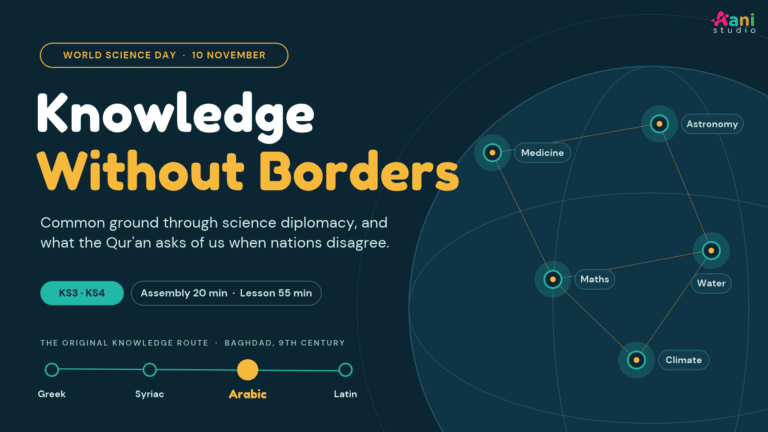
Knowledge Without Borders
World Science Day 2026 KS3–KS4 Lesson & Assembly Slides · Worksheets · Answers · Teacher guidelines · Poster
 Cross-Curricular & Events
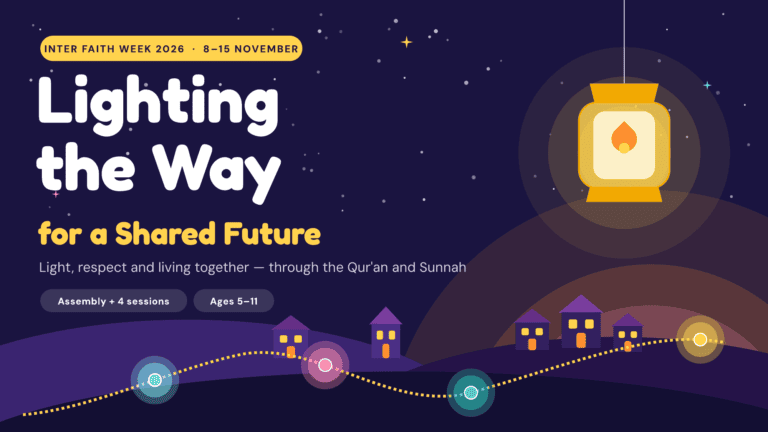
Lighting the Way for a Shared Future
Inter Faith Week 2026 Assembly & Lessons Slides · Worksheets · Answers · Teacher guidelines · Poster
 Cross-Curricular & Events
Stand Tall, Stay Kind
Islamophobia Awareness Month Assembly & Lesson Slides · Worksheets · Answers · Teacher guidelines · Poster
Wish this pack had something extra?
Tell us in Staff Voice. Teachers' ideas shape what we make next.