Lighting the Way for a Shared Future
Inter Faith Week 2026 Assembly & Lessons
About this pack
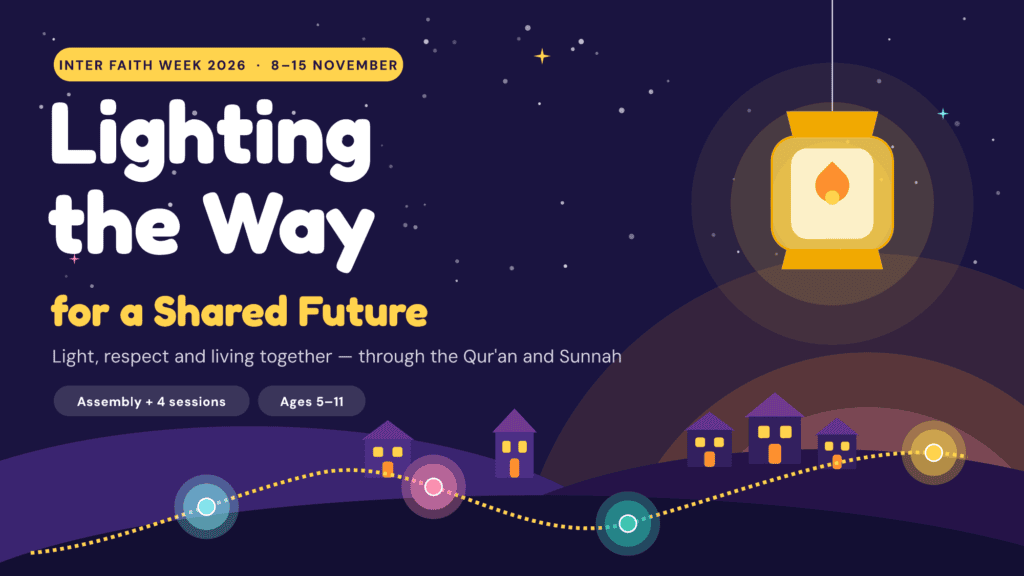
Lighting the Way for a Shared Future is a ready-to-teach Inter Faith Week 2026 assembly and four short lessons for ages 5–11, built on this year's national theme. Pupils learn what light means in the Qur'an, why Allah made people different "that you may know one another" (Qur'an 49:13), and how to be kind and fair to people of every faith while keeping their own worship for Allah alone (Qur'an 60:8 and 109:6). It follows the national structure (Light & Dark, Light Reveals, Light Guides, Lighting the Way Together), so your school can run the national programme through an Islamic lens.
By the end of the week, pupils will be able to:
• Explain that nūr (light) in the Qur'an stands for guidance (Qur'an 24:35, 2:257)
• Correct a common myth: Islam has no official symbol, and light in Islam means guidance
• Retell how the Prophet ﷺ treated people of other faiths, standing for a Jewish man's funeral and saying, "Is it not a living being (soul)?" (Ṣaḥīḥ al-Bukhārī 1312)
• Plan a small good deed with others in their community and keep a Light Pledge
Look inside


A watermarked preview. Members teach the full presentation from the browser.
What’s inside
- PowerPoint: Live 31-slide presentation: a 15–20 minute introduction assembly and four 20–30 minute sessions, with teacher notes on every slide.
- Worksheets & Activities: Three differentiated worksheets and a Light-a-Lamp colouring page and kindness tracker.
- Teacher Answer Sheet: Answers, accepted alternatives and the misconceptions to correct.
- Poster: Qur'an 49:13 and five ways to be a light, for the classroom wall.
- Parent Note: Explains the week to families, with talk-at-home questions and six cut-out Light Pledge cards.
- Teacher Guidelines: Routes and a suggested week, a slide-by-slide map, the Hanafi line for interfaith activities, a full source list, and SMSC and framework mapping.
- Islamic Learning: Qur'an 24:35, 2:257, 49:13, 60:8, 109:6, 41:34 and 5:2, and authentic hadith from al-Bukhārī and Muslim.
Curriculum links
SMSC
- SpiritualReflecting on Allah as an-Nūr, the Guide of the heavens and the earth, and on the duʿā for light.
- MoralChoosing the kind path when a classmate is laughed at or left out.
- SocialPlanning a shared community project and making a Light Pledge.
- CulturalLearning how Hindus, Sikhs, Jewish people, Christians and Zoroastrians use light, while staying true to Islam.
Cross-curricular
- RELight as a symbol across faiths, and respect without blending beliefs.
- PSHERespectful friendships, belonging and including people who are different from us.
- EnglishPoem starters for the national Inter Faith Week Poetry Competition, and kind, curious questions.
- MathsA number code breaker on Worksheet 1.
- CitizenshipMutual respect and tolerance of those with different faiths and beliefs.
SEND & inclusion
- Adaptive Teaching: Support, Core and Challenge routes chosen by reading and independence, never by year group.
- Structured Scaffolding: Word banks, worked examples and three-option choices on the Support tasks.
- Inclusive Participation: Mini whiteboards, partner talk and a colouring tracker, so pre-readers take part too.
- Sensitive by Design: Reflection is always "only share what you're happy to share", and other faiths are shown for learning about, never for joining in.
How this lesson meets your standards
SMSC: Spiritual · Moral · Social · Cultural
British values: Individual liberty · Mutual respect and tolerance
Personal development: Relationships (RSHE) · Life in modern Britain and citizenship
ISI framework: Section 2: Pupils’ education, training and recreation · Section 3: Pupils’ physical and mental health and emotional wellbeing · Section 4: Pupils’ social and economic wellbeing and contribution to society
Performance Standard 2: 2.1 Personal development · 2.2 Understanding of Islamic values and awareness of Emirati and world cultures · 2.3 Social responsibility and innovation skills
Domain 3: Learning outcomes: 3-2 Personal development · 3-2 Social development
Students’ Personal Development and Well-being: Well-being and inclusion: development opportunities · Well-being and inclusion: independent learning and leadership · Students’ behaviour: responsible citizenship
Cambridge learner attributes: Responsible · Reflective · Engaged · Confident · Innovative
IB learner profile: Principled · Open-minded · Caring · Reflective
CASEL competencies: Self-Awareness · Self-Management · Social Awareness · Relationship Skills · Responsible Decision-Making
Personal and Social Well-being: Development of the self · Social responsibility
General capabilities: Ethical Understanding · Intercultural Understanding · Personal and Social capability · Civics and Citizenship
Personal development
- Healthy relationships: being kind and fair to people of every faith.
- Identity: respect for others while keeping their own worship for Allah alone.
- Citizenship: planning a shared community project with others.
- Character: being a light through good deeds.
- Taking action: a Light Pledge and kindness tracker that carry the week home.
FAQ
Who is it for?
Ages 5–11. Support, Core and Challenge routes let one session work across a mixed-age class.
Is it an assembly or lessons?
Both: a 15–20 minute introduction assembly and four 20–30 minute sessions, so you can run it across the whole of Inter Faith Week.
Does it follow the national theme?
Yes. It follows the national structure (Light & Dark, Light Reveals, Light Guides, Lighting the Way Together) through an Islamic lens.
Will pupils take part in other faiths' worship?
No. Pupils learn about how others use light while keeping their own worship for Allah alone (Qur'an 109:6). The teacher guidelines set out the Hanafi line for interfaith activities.
Which Qur'an and hadith does it use?
Qur'an 24:35, 2:257, 49:13, 60:8, 109:6, 41:34 and 5:2, and authentic hadith including Ṣaḥīḥ al-Bukhārī 1312.
What goes home to families?
A parent note with talk-at-home questions and six cut-out Light Pledge cards.
Teacher reviews
Be the first teacher to review this pack.
Members can review a pack after teaching it. Log in
Reviewed by local scholars
Hanafi fiqh throughout
Sources checked
Qur'an and hadith verified before use
Made by teachers
Taught at Aani Academy
More like this
See all Cross-Curricular & Events
The Kindness Effect
World Kindness Day 2026 Assembly & Lesson Slides · Worksheets · Answers · Teacher guidelines · Poster
 Cross-Curricular & Events
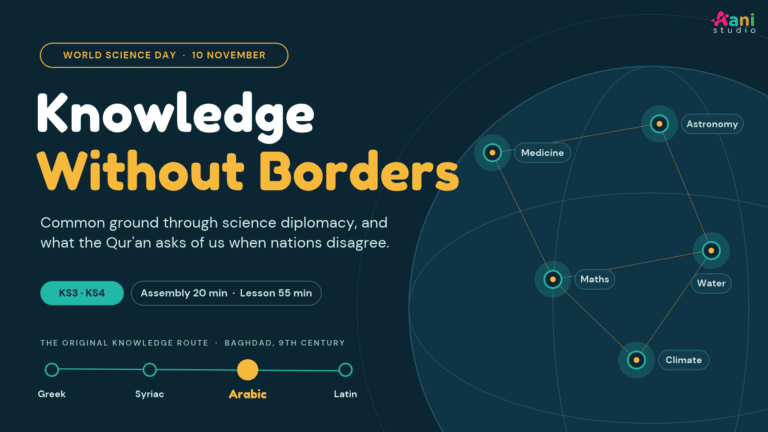
Knowledge Without Borders
World Science Day 2026 KS3–KS4 Lesson & Assembly Slides · Worksheets · Answers · Teacher guidelines · Poster
 Cross-Curricular & Events
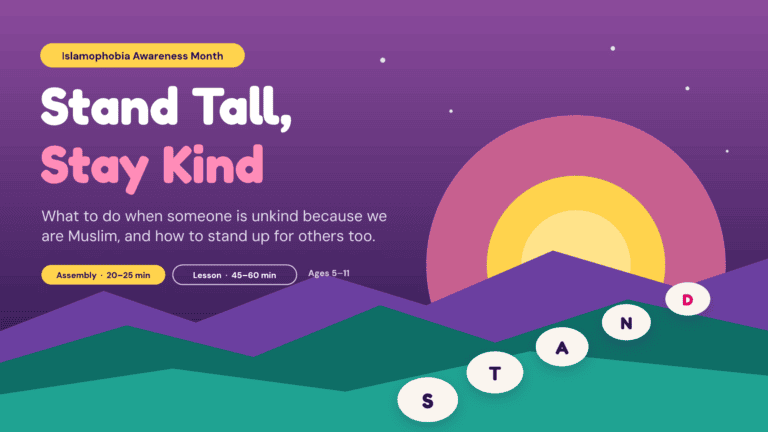
Stand Tall, Stay Kind
Islamophobia Awareness Month Assembly & Lesson Slides · Worksheets · Answers · Teacher guidelines · Poster
 Cross-Curricular & Events
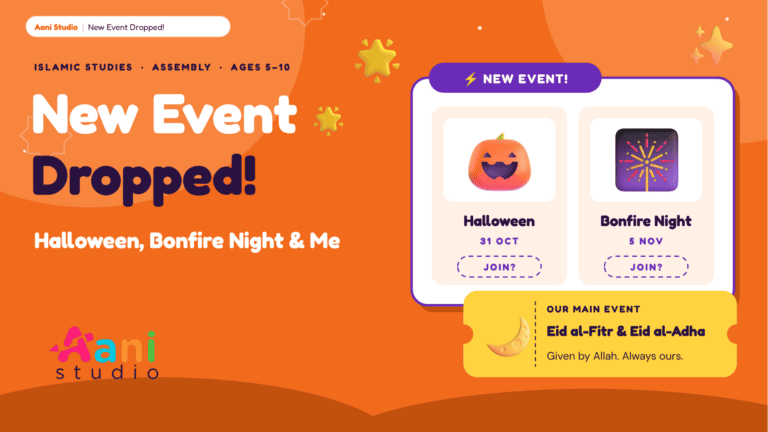
New Event Dropped! Halloween, Bonfire Night & Me
Islamic Studies Assembly Slides · Worksheets · Answers · Teacher guidelines · Poster
Wish this pack had something extra?
Tell us in Staff Voice. Teachers' ideas shape what we make next.