Redefining Strength: Women of Faith
Aani Studio x An-Nasihah

About this pack
In partnership with An-Nasihah Publications. This Key Stage 2–3 lesson asks pupils what true strength looks like, and finds the answer in the lives of the Sahabiyyat. Pupils begin by describing a "strong woman", then meet three women whose strength changed history: Sumayyah (RA), who stood firm in her faith; Khadijah (RA), the first believer, whose loyalty and wealth supported the Prophet ﷺ; and Aisha (RA), the scholar whose knowledge taught generations. "Put yourself in her shoes" choices, a Then vs Now comparison and real-life scenarios help pupils see that strength is not always loud, but it is always real.
By the end of the lesson, pupils will be able to:
• Understand what true strength looks like through an Islamic perspective
• Explore how women of Islam showed courage, faith and resilience
• Reflect on how faith shapes decisions in difficult situations
• Apply lessons from the Sahabiyyat to real-life choices and character
What’s inside
- 11-slide presentation
- 2 worksheets (What Would You Do? and My Strength Journey)
- Teacher guidelines (2 pages)
- A4 poster
Curriculum links
SMSC
- SpiritualReflection on faith and inner strength.
- MoralStanding firm on values, even when it is hard.
- SocialSupporting others and being a positive influence.
- CulturalUnderstanding key female figures in Islam.
Cross-curricular
- REThe Sahabiyyat: Sumayyah, Khadijah and Aisha (RA)
- PSHEPeer pressure, speaking the truth and helping others
- HistoryWomen who shaped the early Muslim community
SEND & inclusion
- Sentence starters for reflection
- Guided discussion prompts
- Choice cards on every story slide
- Stretch: compare types of strength and explain which is hardest
How this lesson meets your standards
SMSC: Spiritual · Moral · Social · Cultural
British values: Individual liberty · Mutual respect and tolerance
Personal development: Relationships (RSHE)
ISI framework: Section 2: Pupils’ education, training and recreation · Section 3: Pupils’ physical and mental health and emotional wellbeing · Section 4: Pupils’ social and economic wellbeing and contribution to society
Performance Standard 2: 2.1 Personal development · 2.2 Understanding of Islamic values and awareness of Emirati and world cultures · 2.3 Social responsibility and innovation skills
Domain 3: Learning outcomes: 3-2 Personal development · 3-2 Social development
Students’ Personal Development and Well-being: Well-being and inclusion: development opportunities · Well-being and inclusion: independent learning and leadership · Students’ behaviour: responsible citizenship
Cambridge learner attributes: Responsible · Reflective · Engaged · Confident
IB learner profile: Principled · Open-minded · Caring · Reflective
CASEL competencies: Self-Awareness · Self-Management · Social Awareness · Relationship Skills · Responsible Decision-Making
Personal and Social Well-being: Development of the self · Social responsibility
General capabilities: Ethical Understanding · Intercultural Understanding · Personal and Social capability
Teacher reviews
Be the first teacher to review this pack.
Members can review a pack after teaching it. Log in
Reviewed by local scholars
Hanafi fiqh throughout
Sources checked
Qur'an and hadith verified before use
Made by teachers
Taught at Aani Academy
More like this
See all Cross-Curricular & Events
The Kindness Effect
World Kindness Day 2026 Assembly & Lesson Slides · Worksheets · Answers · Teacher guidelines · Poster
 Cross-Curricular & Events
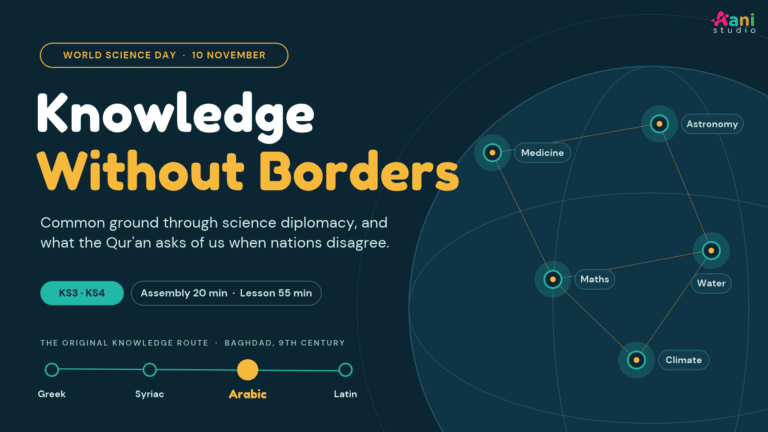
Knowledge Without Borders
World Science Day 2026 KS3–KS4 Lesson & Assembly Slides · Worksheets · Answers · Teacher guidelines · Poster
 Cross-Curricular & Events
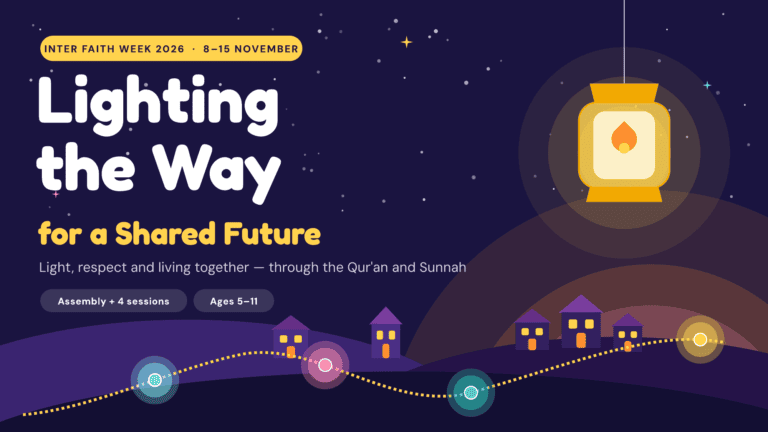
Lighting the Way for a Shared Future
Inter Faith Week 2026 Assembly & Lessons Slides · Worksheets · Answers · Teacher guidelines · Poster
 Cross-Curricular & Events
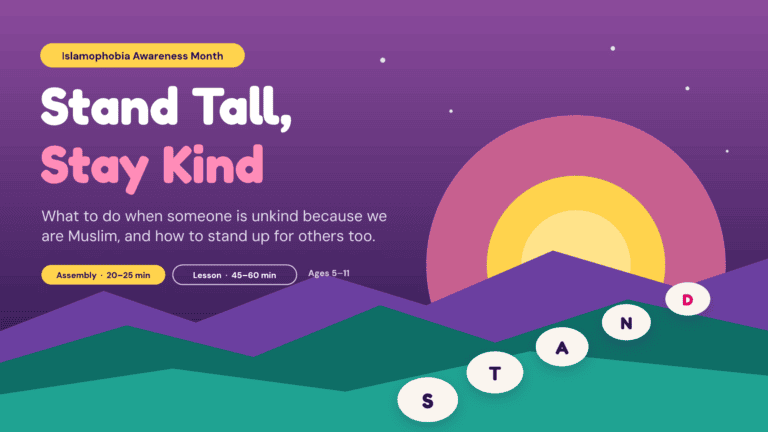
Stand Tall, Stay Kind
Islamophobia Awareness Month Assembly & Lesson Slides · Worksheets · Answers · Teacher guidelines · Poster
Wish this pack had something extra?
Tell us in Staff Voice. Teachers' ideas shape what we make next.